Core concepts
Concentrated Liquidity
What is it?
Popularized by Uniswap V3, concentrated liquidity enables liquidity providers to focus their capital within specific ranges, tightening spreads and reducing slippage while that liquidity is active.
To get an idea of what Concentrated Liquidity offers we can compare it to a more centralized, and well-known, liquidity scheme: an Order Book.
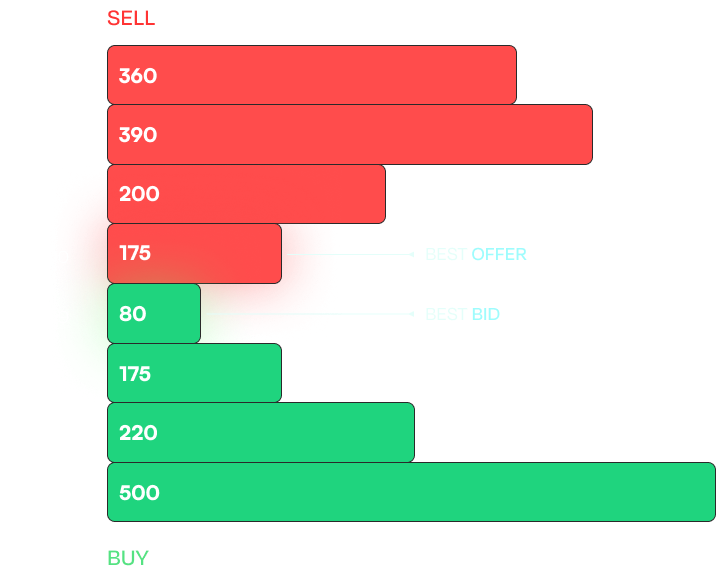
In the depth chart above, bids (buys) and asks (sells) are clearly shown. The available depth shows how a market order would move through quoted prices and affect its average execution price.
Ramses CL
Ramses is an orderbook-style AMM optimized for performant liquidity providers (LPs). By allowing LPs to concentrate their capital within specific price ranges, Ramses creates deep liquidity zones that mirror traditional orderbook depth charts, while maintaining the benefits of automated market making.
In a Uni V2 liquidity pair, liquidity positions are spread across a range from 0 to infinity (0,∞). This means that each liquidity provider must distribute their capital across every possible positive real number.
Liquidity spread from 0 to ∞ is exponentially less efficient than, say, one with a defined range of $3400-$3500. By focusing liquidity in a narrower range, concentrated liquidity pools can improve slippage, as more liquidity is available to support trades at desired prices, reducing the price impact of transactions.
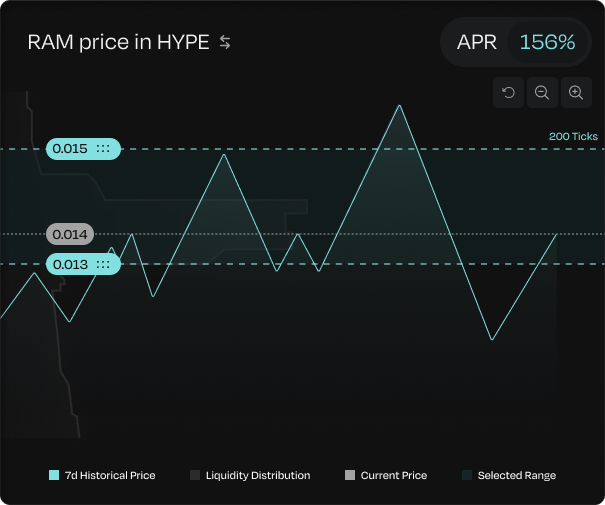
The cyan line represents the 7 day historical price range of the pool. This historical context helps liquidity providers visualize price volatility before selecting their position ranges.
The shaded area on the left represents the liquidity depth summed between all ticks within the liquidity pool (within the same fee-tier, more on this here).
The horizontal markers represent the range of the position. In the context of automated market makers (AMMs), a "range" is an interval between two usable ticks. The marker also displays the number of ticks within the range.
Order Book View
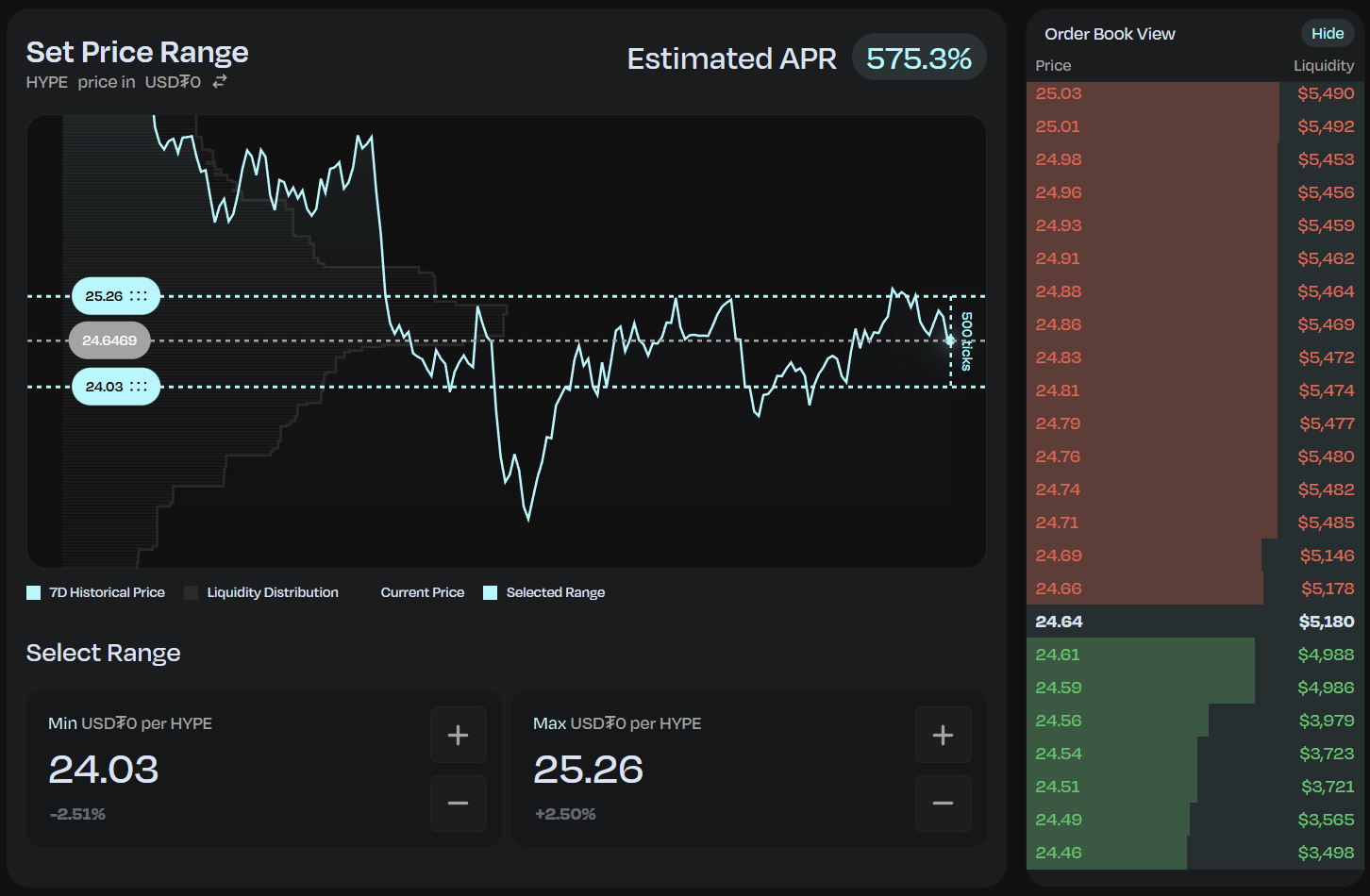
Ramses has also introduced an Order Book View for users who want to provide liquidity in Concentrated Liquidity (CL) pools. This feature presents CL positions in a familiar traditional order book format, allowing users to create and manage liquidity positions more intuitively. For traders accustomed to order book–based trading, this significantly lowers the barrier to entry for participating in liquidity provision and managing positions effectively.
Alice and Bob
Consider Alice and Bob providing liquidity to a HYPE / USD₮0 pool with HYPE at $50. Each has $1,000,000 available, but they take different approaches:
| Alice's AMM Strategy | Bob's CL Strategy |
|---|---|
| Spreads her entire $1,000,000 across the full price range. Traditional "set it and forget it" strategy. | Allocates approximately $48,927 within the $45-$55 price range. Keeps approximately $951,073 for other opportunities. |
| Provides full-range liquidity at every positive price. | Provides approximately the same liquidity depth as Alice while HYPE remains between $45 and $55, using less deposited capital. |
| Remains active across the full price curve. | Becomes inactive and entirely one-sided after price moves beyond a range boundary, until price re-enters the range or Bob adjusts the position. |
The estimate uses standard concentrated-liquidity formulas, a $50 spot price, and ignores fees and rounding. Equal liquidity depth does not guarantee equal or higher returns. Realized fees and rewards depend on trading volume, fee configuration, competing active liquidity, in-range time, gauge eligibility, and incentives.
Concentrated liquidity can provide more depth per dollar while a position is active. It also concentrates inventory and price risk: an out-of-range position stops supporting trades and is held entirely in one asset.
Competitive Farming
Competitive farming rewards liquidity that is active and eligible for a pool's gauge. In concentrated liquidity models, users choose the tick-aligned price interval in which they want to provide liquidity.
What are the benefits?
Concentrating a position can provide more active liquidity per dollar, but only while the market remains inside the selected range. A position's rewards depend on its active liquidity share, in-range time, gauge eligibility, votes, and any additional incentives. Productive liquidity can improve execution and help a pool become a preferred routing destination for aggregators.
Trading volume generates swap fees. Under the default Ramses configuration, gauged pools direct those fees to xRAM voters, while RAM emissions paid to eligible LPs depend on gauge votes.
How does this differ from other models?
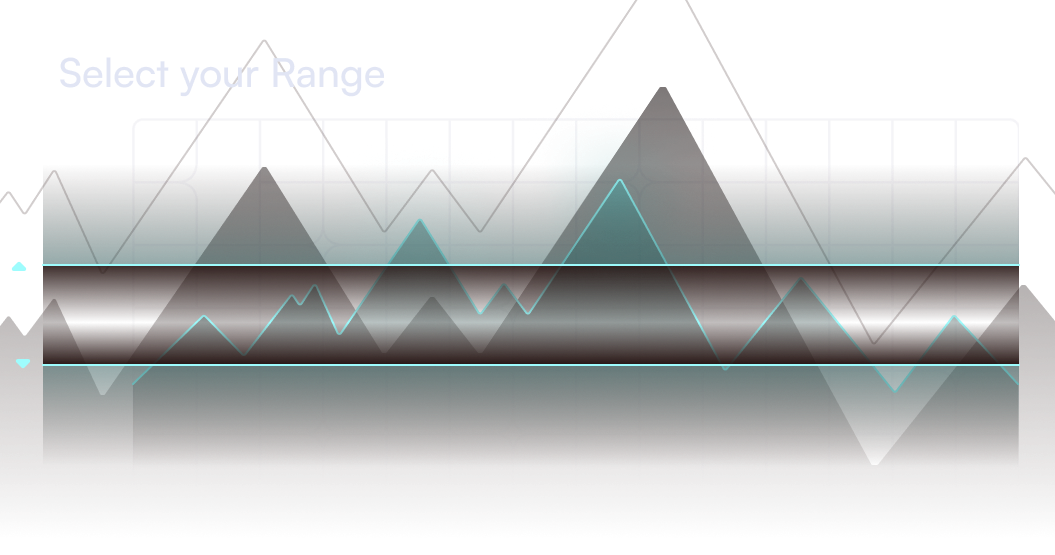
Concentrated liquidity can provide substantially more depth per dollar than full-range liquidity, but the improvement depends on range width, current price, and competing active liquidity. Tighter ranges increase capital efficiency while active, but also increase the chance of going out of range and can increase inventory, adverse-selection, and rebalancing risk.
No range guarantees higher earnings. Users should weigh expected fees and incentives against price risk, inactive time, and management costs.
Range Orders
In orderbooks, anyone can easily set a limit order to buy or sell an asset at a predetermined price, allowing the order to be filled at an indeterminate time in the future.
With concentrated liquidity, you can approximate a limit order by providing a single asset as liquidity within a specific range. Like traditional limit orders, range orders are set with the expectation they will execute at some point in the future, with the target asset available for withdrawal after the spot price has crossed the full range of the order.
A range order is still a liquidity position. While it is active, it may earn fees or gauge rewards depending on the pool's fee configuration and whether the position is eligible and staked. Earnings are not guaranteed.
Take-Profit Order
Selling HYPE for USD₮0
The current price of the HYPE / USD₮0 pool is $40. To begin selling HYPE when price reaches approximately $45, you can provide HYPE in a range such as $45-$46. The position converts HYPE into USD₮0 as price moves through the range and is fully converted only after price crosses the upper boundary. Execution occurs across the range, not at one exact price.
Buy Limit Order
Selling USD₮0 for HYPE
The current price of the HYPE / USD₮0 pool is $45. To begin buying HYPE if price falls to approximately $42, you can provide USD₮0 in a range such as $41-$42. The position begins converting below the upper boundary and is fully converted only after price crosses the lower boundary.
Unlike a traditional limit order, a range order remains active after it has converted. If price reverses through the range before the liquidity is removed, the position can automatically convert back into the original asset. Remove liquidity after full conversion if the goal is to keep the destination asset. A tighter range narrows the execution interval but does not remove reversal risk.
Impossible Range Order Types
| Buy Stop Orders | Stop-Loss Orders |
|---|---|
| Cannot place USD₮0 orders above current price | Cannot place HYPE orders below current price |
When setting range orders, consider the execution interval carefully. A wider range may remain active longer and execute across more prices, but provides less concentrated liquidity per dollar. Any completed conversion can reverse while the position remains deployed.
Fee Tiers
There are multiple default fee tiers when creating a Concentrated Liquidity position on Ramses:
| Fee Tier | Tick Spacing | Best Used For |
|---|---|---|
| 0.01% | 1 | Highly correlated and pegged assets |
| 0.025% | 5 | Competitive asset classes with moderate volatility |
| 0.05% | 10 | Standard fee tier for most trading pools |
| 0.3% | 50 | Higher volatility assets |
| 1% | 100 | Exotic pairs with significant volatility |
| 2% | 200 | Highly volatile or illiquid assets |
Distribution
By default, swap fees are distributed according to the pool's gauge state:
| Pool State | Liquidity Providers | xRAM Voters | Protocol / Sarcophagus |
|---|---|---|---|
| Gauged | 0% | 100% | 0% |
| Fee-only / Ungauged | 95% | 0% | 5% |
These percentages can be configured per pool to better align with specific market conditions and liquidity requirements.